
Do you ever get dressed up, open your camera, and suddenly feel like your body looks heavier than it feels?
That was the moment I noticed it.
I was wearing a pretty outfit.
Hair done.
Makeup done.
Ready to take one quick selfie before leaving.
But when I looked at the photo, my face looked fuller.
My waist looked thicker.
My whole body looked like it was holding onto something.
I used to take a photo, pick the one I liked, and post it.
Now I caught myself doing the same thing every time.
Slim my face.
Pull in my waist.
Retake the angle.
Delete it anyway.
Do you ever feel like you gained weight even when you did not eat that much?
Do you ever feel bloated by the afternoon, like your jeans are pressing harder into your waist?
Do your socks sometimes leave deeper marks around your ankles?
Do you ever wake up with puffy eyes and heavy under-eye bags before the day even starts?
Do you feel tired, then blame yourself for being lazy?
If more than one of those felt familiar, keep reading.

My name is Mia.
I am 36.
I work at a desk most days.
I am not a fitness influencer.
I am not someone who wakes up excited to meal prep.
I am just a woman who started feeling like her body was holding onto everything.
Some days it was my face in selfies.
Some days it was the tight line my waistband left on my skin.
Some days it was the sock marks that stayed too long after I took them off.
Some days it was that uncomfortable "full" feeling that made every outfit feel wrong.
I kept thinking, I must be gaining weight.
And because it looked like weight gain, I treated it like weight gain.
I started trying to "fix" it like I was gaining weight
First, I ate less.
Then I skipped breakfast.
Then I cut snacks.
Then I added more cardio.
Then I started choosing clothes based on how much they could hide.
I also started editing every picture harder.
Not because I wanted to look perfect.
Because I wanted to look like myself again.
For a week or two, I felt disciplined.
Then I felt tired.
Then I felt annoyed.
Because the problem did not really go away.
My weight was not changing much.
But I still had those days where I looked puffy, felt full, woke up with heavy-looking eyes, and wanted to cancel plans.

The first doctor visit did not go the way I expected
I finally booked an appointment because I wanted someone to tell me what diet I should do.
My doctor did not start there.
She asked about my sleep.
My workday.
How much I sat.
Whether my rings, socks, or waistband ever left stronger marks.
Whether my face looked puffier in the morning.
Whether my stomach felt bloated even on days I had not eaten much.
How often I felt "puffy" versus truly heavier.
Whether it seemed to come and go.
Then she asked the question that made me stop talking.
She told me she sees this all the time.
Women come in convinced they are gaining weight.
They say their selfies look different.
Their waist feels tighter.
Their face looks more tired.
Their body feels heavier than it should.
But sometimes what they are describing is not a fat-loss problem.
It can be a daily fluid-balance and lymphatic-flow support problem.
Her words were very clear:
This was not about treating a disease.
It was about supporting my body's normal flow better.
The belief I had to break
I thought the answer was "lose more weight." My doctor helped me see that some women need a daily support routine for puffiness, fluid balance, and normal lymphatic function. That means hydration, movement, sleep, less panic, and gentle support instead of treating every tight waistband like a personal failure.
I tried to fix it myself again. That was mistake number two.
I left that appointment feeling smart.
Then I went home and did what I always do.
I overcomplicated it.
I bought another tea.
I saved three "lymph massage" videos.
I tried sleeping with my head higher because I was tired of waking up with puffy eyes.
I changed leggings because the waistband marks made me feel worse.
I tried to drink a huge amount of water for two days, forgot on day three, and felt like I had failed again.
I still did not have a routine.
I had random attempts.
So I went back to my doctor and asked a better question:
Why she told me to stop looking for a stronger detox
She said the goal was not to "flush everything out."
That kind of language sounds dramatic.
But it usually leads to harsh products, short-term panic, and routines people quit.
Instead, she wanted me to look for something gentle enough to use consistently.
No bathroom-emergency tea.
No complicated powder ritual.
No product promising overnight fat loss.
Something that fit a normal day.
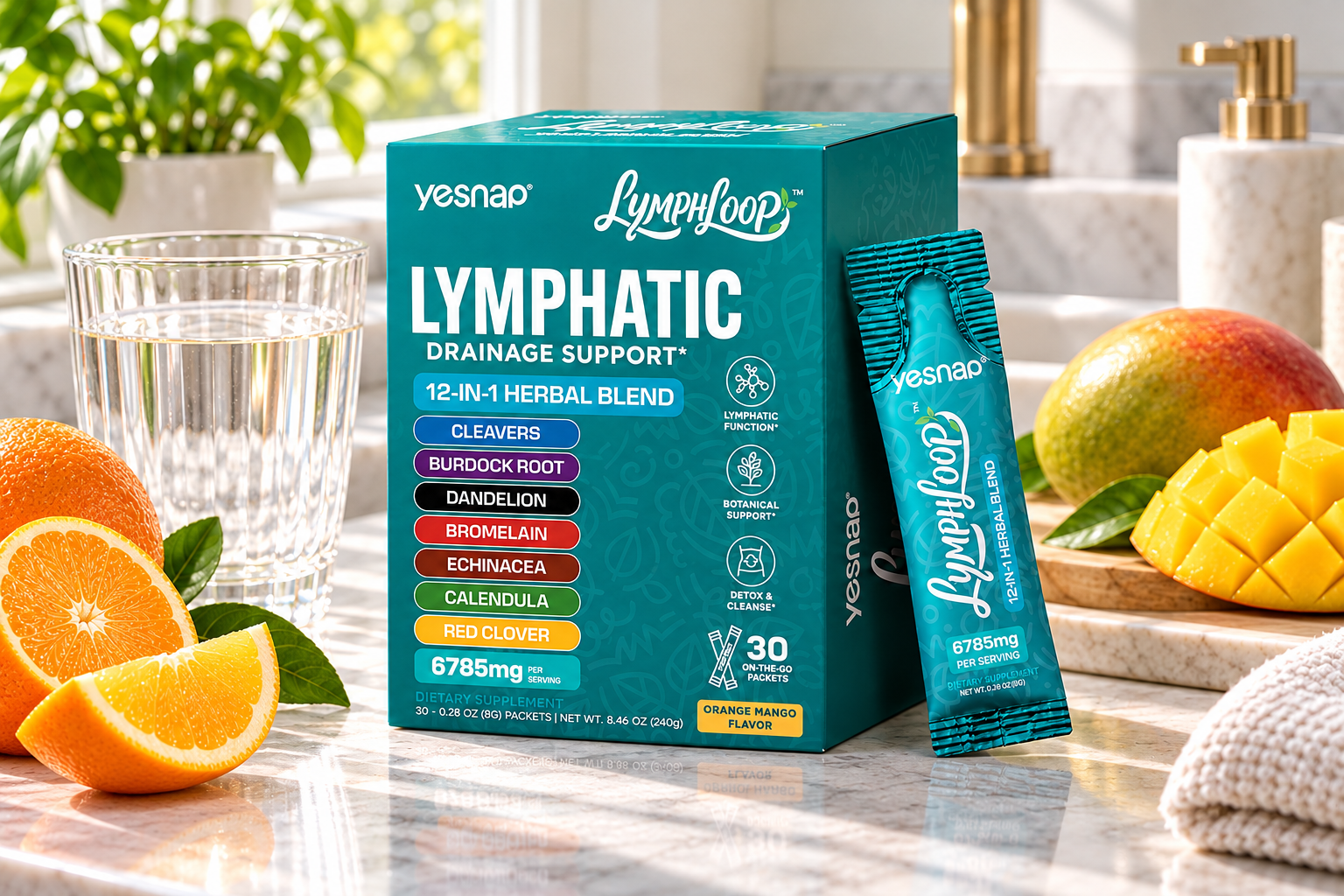
That is when she mentioned YESNAP LymphLoop Lymphatic Drainage Support.
Why my doctor liked this better than my random self-experiments
YESNAP LymphLoop is a 12-in-1 herbal support drink designed to support healthy lymphatic function and daily fluid balance. It comes as ready-to-take liquid stick packs, so I did not have to measure, brew, mix, or turn my kitchen into a wellness lab.
Why the formula made sense once I understood the problem
I did not need another "skinny" product.
I needed a support routine for the thing I kept mistaking for weight gain every time a selfie looked wrong or my clothes left marks.
The botanical core includes cleavers, burdock root, dandelion, and bromelain.
The full 12-in-1 blend also includes herbs such as echinacea, calendula, red clover, rutin, turmeric, astragalus, milk thistle, and black pepper.
My takeaway was simple:
This was not a magic stick.
It was a daily support product that finally matched the problem I was actually having.
Not another diet
I stopped treating every puffy day like proof that I needed to eat less.
Not a harsh detox
I wanted daily support, not a product that made me scared to leave the house.
Not a complicated ritual
One stick was easier to repeat than another routine I would quit by Friday.
What changed when I stopped trying to shrink myself
Nothing dramatic happened overnight.
That almost made me trust it more.
Week one was mostly about consistency.
I kept a stick in my bag.
I drank more water.
I stopped skipping breakfast to "earn" a flatter day.
I walked after lunch when I could.
By week two, I noticed I was not spiraling as hard when my face looked puffy in the morning.
By week three, my waistband and sock marks were not controlling my mood the same way.
By week four, I was taking selfies again without automatically reaching for the slimming tool.
And I was going out again without planning my outfit around hiding.

Water, breakfast, and no panic because my eyes looked tired.
One YESNAP LymphLoop stick when it fit naturally into my routine.
A short walk or standing break when my waist started feeling tight.
Less canceling plans and less editing myself out of photos.
The social proof I did not expect
The first person who noticed was not me.
It was my coworker.
She said, "You look less tired lately."
Then my sister asked if I had changed my skincare because my face looked less puffy in our video call.
Then a friend at dinner said, "You seem way more comfortable in your clothes."
Nobody said, "You lost so much weight."
That was the point.
I did not feel like I had become a different person.
I felt like the puffy, uncomfortable, photo-editing version of me was not running the whole day anymore.

Who I would recommend it to
I would recommend YESNAP LymphLoop to the woman who keeps asking herself:
Why do I feel like I gained weight when I did not eat that much?
Why does my face look puffy in selfies lately?
Why do my socks, rings, or waistband leave marks that make me feel swollen?
Why do I wake up looking tired around my eyes?
Why do I feel bloated, heavy, or uncomfortable even when the scale is not moving much?
If you nodded at more than one of those, this is exactly the kind of story I wish I had read earlier.
I would not recommend it as a cure for medical swelling, sudden swelling, painful swelling, one-sided swelling, or any condition that needs a clinician.
And I would not recommend it to anyone looking for overnight fat loss.
For me, it became the product that helped me stop treating every uncomfortable day like a failure.
One orange-mango stick. No brewing, scooping, or panic spiral.
If your daily issue feels less like "I need to lose weight" and more like "I need support for the puffiness I keep mistaking for weight gain," YESNAP LymphLoop was built for that kind of routine.
Try YESNAP LymphLoopMia, Lena, and the doctor are composite characters in a UGC-style dramatized story based on common daily puffiness and self-blame concerns; this is not a verified customer testimonial or medical advice. Individual experiences vary. YESNAP LymphLoop supports healthy lymphatic function and daily fluid balance; it is not intended to diagnose, treat, cure, or prevent any disease. Follow the product label and consult a qualified healthcare professional if you have medical concerns, take medications, are pregnant or nursing, or experience sudden, severe, painful, persistent, or one-sided swelling.